
Why it matters: Google calls Suncatcher a long-term research moonshot to explore powering AI compute in space, and says proving its chips can run reliably in orbit clears the way for a pair of linked satellites in 2027.
Google said on Oct 30 that its Project Suncatcher prototype satellite has produced what the company calls the first-ever AI response from a data center class TPU in orbit. TPUs, or Tensor Processing Units, are the chips Google designs for AI workloads in its data centers.
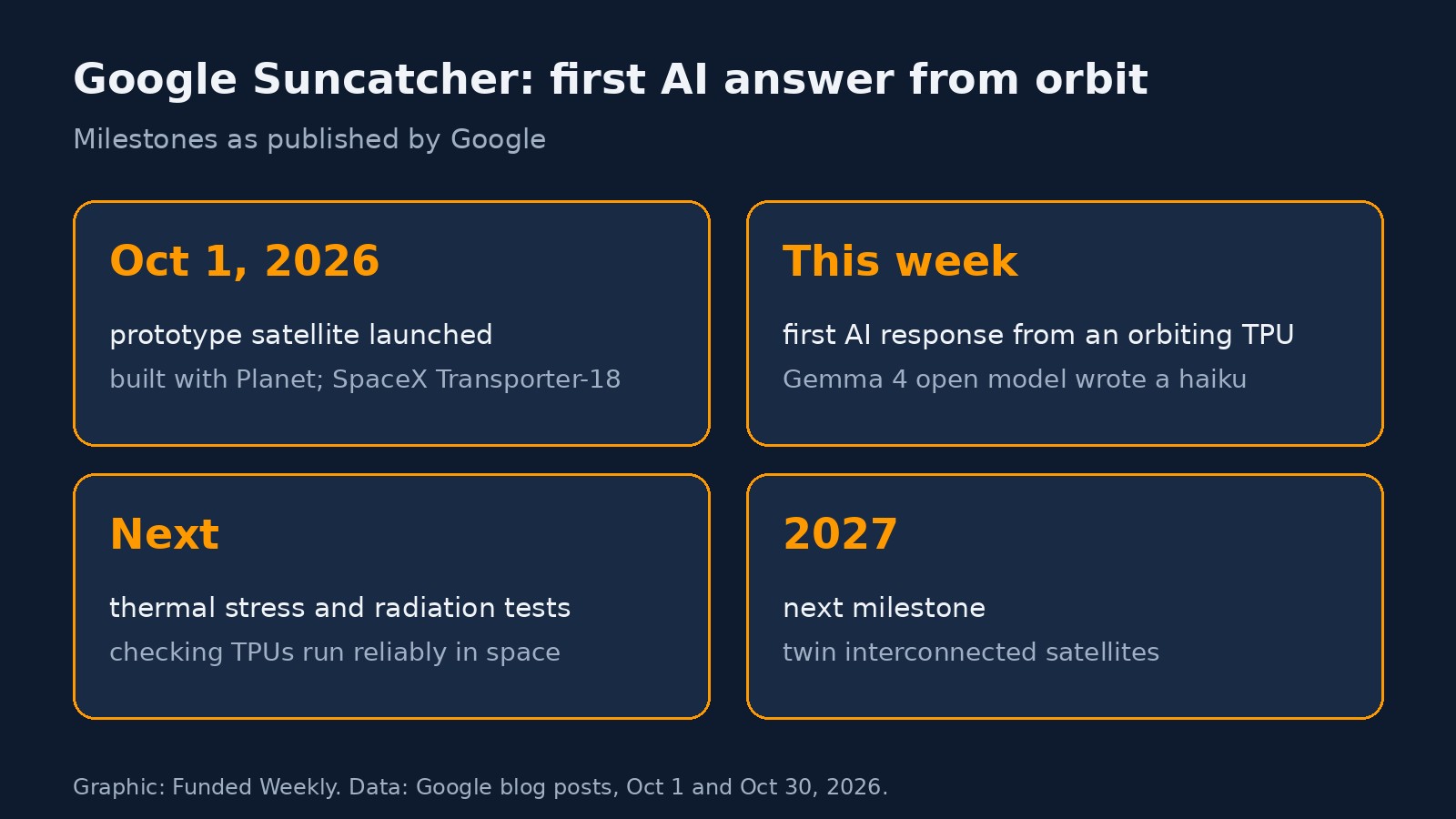
The test: Google says that during a ground-station pass it sent a prompt to the Gemma 4 open model running on board, asking for a haiku about being in space. The answer came back as the satellite passed over Svalbard, Norway, opening with the line "Blue marble below." Google says it then tried space-themed limericks and prompts that asked the payload to report its own technical status.
How it got here: The satellite, built with Planet, went into orbit Oct 1 on SpaceX's Transporter-18 rideshare mission. Google says it spent the following weeks on a commissioning checklist that included powering up the host and TPU trays and running early machine learning tests.
What comes next: Google says it will run tests on how its TPUs perform under thermal stress and radiation exposure in orbit. It says confirming the chips can reliably run workloads in space is a step toward its next milestone, twin interconnected satellites in 2027. When the prototype reached orbit, Google said its research behind the mission was published as a peer-reviewed paper in the journal Joule.
Sources
- Google blog: "We've received our first response from the Project Suncatcher prototype satellite," Oct 30, 2026
- Google blog: "Our Project Suncatcher prototype satellite is in orbit," Oct 1, 2026
How we checked this: We read Google's Oct 30, 2026 and Oct 1, 2026 blog posts on Project Suncatcher, saved on Oct 30, 2026 at 5:07 PM ET, and checked each date and claim in this story against them. Milestone descriptions are Google's own.
See something wrong? Tell us and we'll fix it. Every fix is dated and listed on our Corrections page.